
D’Onofrio Consulting Partners

Success of executive coaching

The Impact of Executive Coaching

December 1, 2016
Reyes Liske, J. M., & Holladay, C. L. (2016). Evaluating coaching’s effect: competencies, career mobility and retention. Leadership & Organization Development Journal, 37(7), 936–948.


Introduction

A recently published study explored the impact of an executive coaching program (consisting of executive coaching and group coaching) in a U.S. healthcare organization. Results indicated that leaders who participated in the program demonstrated significantly improved leadership competencies and significantly higher retention rates one-year post-program, compared to the control group.


Methodology

Employing a group of 84 leaders (25 men & 59 women) and a control group of 67 participants, the researchers used a 360-degree assessment pre and post coaching that measured six leadership competencies (thinking, interpersonal, communication, people leadership, self-management and technical knowledge).


Findings

  • A significant change in leaders’ competencies was found in pre and post 360 assessment ratings. The 360 reassessment was conducted nine months after the conclusion of the coaching program which lasted 9 months. An improvement was also found in all six competencies when compared to the control group.
  • Higher promotion and retention rates were found one-year post-program when the two groups were compared.
  • Significantly higher gains were observed in thinking, people leadership and communication competencies compared to the interpersonal, self-management and technical knowledge competencies.

Practical Implications

Measuring the return on coaching investment has remained an elusive goal for many organizations. This study contributes to the relatively sparse tangible impact of coaching within organizations.

“The initial findings from this study provide evidence of the positive impact the coaching program can have for individuals who are in a supervisor to executive level capacity to further strengthen their own self-awareness along with their leadership abilities. The findings further suggest the appropriateness of such interventions and support organizations making coaching programs available to these leaders.”

The study researchers noted a limitation of their study – the inability to distinguish between one-on-one coaching, group coaching or the combination of both – on the study’s results. They conclude with a recommendation for future research on the two coaching modalities.

Full Article Link


Recommended Reading and References

  • ROI Institute. Founded in 1992 by Jack J. Phillips, Ph.D. and Patti P. Phillips, Ph.D. the ROI Institute focuses on measuring and evaluating training, human resources, technology and quality programs and initiatives.

Does Transformational Leadership Promote Innovation?

November 1, 2016

Introduction

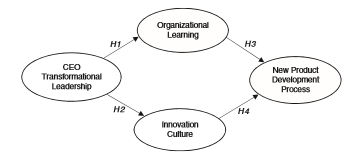
Is there a link between CEO transformational leadership style and new product development (NPD)? The authors of a new study found strong evidence to suggest there is. They also found a connection between organizational learning and innovation culture and the NPD process. Their findings can help organizations improve their NPD processes and achieve greater new product success.

CEO transformational leadership is positively associated with organizational learning.In their study of 269 small, medium and large manufacturing companies in five industries in Thailand, Sattayaraksa and Boon-itt tested four hypotheses:

  1. CEO transformational leadership is positively associated with innovation culture.
  2. Organizational learning is positively associated with the NPD process.
  3. Innovation culture is positively associated with the NPD process.

Data was collected from organizational leaders (managers through CEOs/presidents) using a self-report questionnaire.


Findings

Sattayaraksa and Boon-itt found important linkages between CEO transformational leadership and the NPD process:

  • Transformational leadership is strongly and positively associated with the organizational learning – those processes in which information and knowledge is acquired and managed. This translates into stronger organizational performance. (0.76 correlation was found between CEO transformational leadership and organizational learning)
  • Transformational leadership also influences values and beliefs that promote communication, risk-taking and new opportunity exploration. Transformational leaders can create an innovation culture by stressing core innovation values, rewarding innovation and encouraging new approaches. (0.78 correlation was found between CEO transformational leadership and innovation culture)
  • There is a strong and positive correlation between organizational learning and the NPD process.Organizations can leverage customer and market feedback and translate these insights to the NPD decision-making process. (0.64 correlation was found between organizational learning and the NPD process)
  • While there is evidence that an innovation culture directly affects the NPD process, an innovation culture does not strongly influence the implementation of this process. (0.19 correlation was found between the two)

“Google CEO and founders have demonstrated transformational leadership in making Google one of the most innovative companies in the world, by creating a fun environment and a relaxed culture in which creativity thrives.” Oke et al. (2009)

A key takeaway from this new study is the finding that CEOs with transformational leadership styles indirectly influence the NPD process by way of organizational learning and innovation cultures. Sattayaraksa and Boon-itt conclude with three practical recommendations:

  1. CEOs should develop skills and behaviors on the four dimensions of transformational leadership. Organizations should integrate transformative leadership to their leadership development initiatives.
  2. Leaders should strengthen the company’s organizational learning capability, to benefit the NPD process.
  3. Leaders and R&D managers should foster innovation cultures by encouraging openness, risk taking, and exploring new opportunities as a benefit to the NPD process

Recommended Reading

Are Current Leadership Theories Relevant to Millennials?

October 1, 2016

Introduction

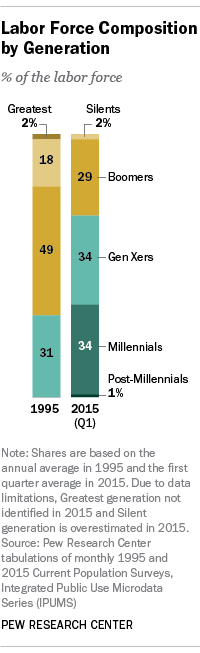
Labor Force Composition by GenerationThe authors of this Leadership Quarterly article question whether five contemporary leadership theories are relevant to Millennials (those born between 1981-1997 who make up the largest generation cohort of the working population as of 2015).
This paper is an important read for all leaders and HR professionals whose leadership approaches are based on current theories.

The five leadership styles called out in this article are as follows (definitions from Wikipedia):

  • Transformational leadershipLeaders that follow the transformation style of leading, challenge and inspire their followers with a sense of purpose and excitement.
  • Information processing: Focuses on the role of social perception in identifying leadership abilities.
  • Leader-member exchangeA relationship-based approach to leadership that focuses on the two-way (dyadic) relationship between leaders and followers.
  • Authentic leadership: Emphasizes building the leader’s legitimacy through honest relationships with followers which value their input. By building trust and generating enthusiastic support from their subordinates, authentic leaders are able to improve individual and team performance.
  • Ethical leadershipis leadership that is directed by respect for ethical beliefs and values and for the dignity and rights of others.

Findings

Anderson et al highlighted important generational shifts or gaps, based on a broad range of cited research studies. They conclude that Millennials:

  • Seem to be more individualistic and less altruistic at work than earlier generations of employees and have lower concern for others
  • Value work-life balance and meaningful lives outside of work, including leisure activities

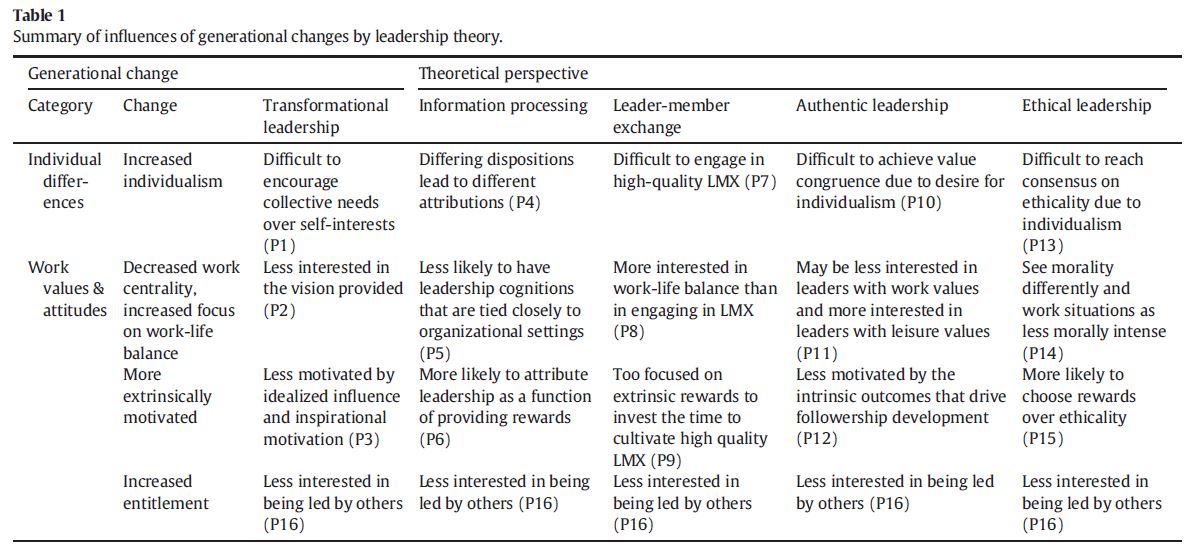
They argue that these gaps can impact a leader’s ability to manage and influence. Fifteen “propositions” are advanced in an attempt to highlight the limitations and currency of the five current leadership theories. These are summarized in the table below.

“Several of our most widely researched theories of leadership may be stretched by the changing dispositions and values of the work force. We would contend that generational shifts have dictated a reevaluation of the applicability of many of our classic leadership approaches how they might be useful in leading the newest generation of organizational entrants. Given the generational shifts that have been discussed, managers and future researchers need to be mindful of both the adequacy and adaptability of these theories for the latest organizational entrants.”

The authors conclude with five recommendations for leaders on ways to adapt each of the current leadership theories, as well as practical steps for HR leaders. They offer suggestions for future research, pointing out that as the workforce changes, so too must the leadership theories. The authors note that Millennials are already assuming leadership roles and it is important to understand how they may be different because of the generational shifts.

Full Article Link


Recommended Reading

2016 Trends in Human Capital and Executive Coaching

September 1, 2016

Two important reports have been published in the last six months which will be of interest to Human Resource professionals. In this post, we review the key findings from both studies that relate to leadership development.

Deloitte’s Global Human Capital Trends 2016 – 10 trends are identified in this year’s study, spanning organization design and culture; learning, leadership, and workforce management; and even the HR function itself. Results were compiled from surveys and interviews from over 7,000 human resources and business leaders in 130 countries.

In the following 29 minute clip, Deloitte’s Josh Bersin and Nicky Wakefield discuss the most surprising and significant results from this year’s study, at the heart of which is the high incidence of planned or actual organizational redesign, reported by 75% of survey respondents. The need for greater customer-focus and agility has hastened the growth of team-based organizations, structured by products, projects, teams and geographies. Factors such as changing demographics, digital transformation, data analytics and contingent labor are also addressed.

Clearly, organizations are grappling with the leadership implications of these changes. In fact leadership is ranked second in importance (behind organizational design) in terms of its importance:

“Fully 89 percent of executives in this year’s survey rated the need to strengthen, reengineer, and improve organizational leadership as an important priority. The traditional pyramid shaped leadership development model is simply not producing leaders fast enough to keep up with the demands of business and the pace of change.” Deloitte

One key take-away from the study is the finding that high-performing organizations spend up to four times as much on leadership development than average organizations and their c-suites and boards are actively involved in developing leaders.


Conference Board 2016 Ninth Bi-Annual Executive Coaching

The Conference Board study is smaller in size and scope but also noteworthy. 181 organizations participated in this year’s survey from around the world and the report also includes expert interviews and case studies from world-class organizations such as Google and MD Anderson. Key themes and trends include:

  • Coaching has evolved from remedial to developmental in focus and is used at all organization levels. The trend is to incorporate coaching at levels below the c-suite and senior organization levels. Leaders are being identified at lower levels and prepared for future roles. Coaching use is shifting from addressing current performance needs and issues to being developmental in focus – a key tool to develop leaders for future roles.
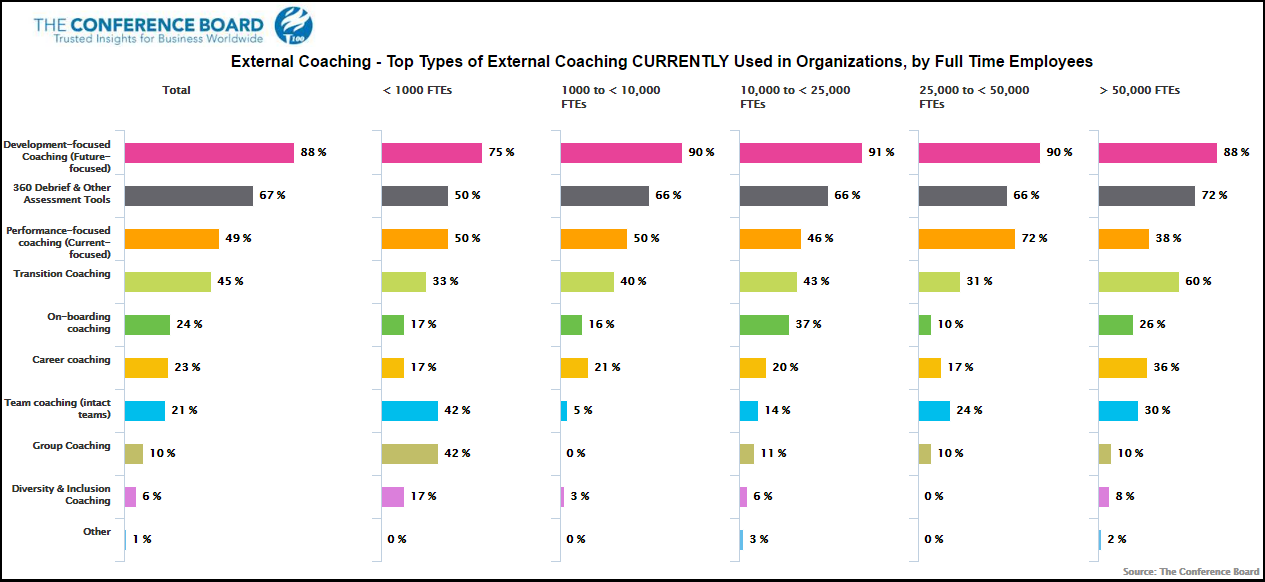
  • Coaching is a component of leadership development programs. Coaching complements other approaches to leadership development and is targeted. The chart below shows the types of coaching currently used by company size (as measured by number of full time employees).
  • Coaching evaluation remains rudimentary. Companies continue to be dissatisfied with their evaluation methods, which for one-third of respondents involves formal and informal conversations with stakeholders. The report discusses Google’s approach which uses a rating system in an effort to improve measurement methods.
  • Use of internal coaching remains strong. Internal coaching is viewed as a cost-effective, scalable approach to developing the next generation of leaders. Sixty-nine percent of companies use internal coaches today and the same percentage anticipates doing so in the future.
  • Developing a coaching culture gains momentum. A greater focus is being placed on developing a coaching culture across the organizations studied and the study’s researchers predict this will continue to take center stage in the coming years.

Recommended Resources

  • Global Human Capital Trends 2016 – this site includes a wealth of information from this year’s study, including an interactive dashboard to benchmark your organization, downloadable report PDF, ten trends, infographic and online course (see below). All materials are free to access.
  • Global Human Capital Trends Course –  this free online course is offered by Columbia University’s School of Professional Studies in collaboration with Deloitte and covers the top-10 trends in global talent management. Course participants will learn the implications of these trends — from developing a flexible team-based organizational structure to enhancing employee positivity and productivity — and how their organization can address each effectively. Open to all, the Human Capital Global Trends Course is ideal for HR and other business professionals.

Women on Boards: The Superheros of tomorrow?

August 1, 2016

Introduction

The number of women on boards is not shifting according to Catalyst whose census indicates that 19.9% of board seats were held by women last year, compared with 19.2% the year prior. Meanwhile, a new research paper by Adams suggests the number is smaller than we think. In her paper, she questions the evidence that corporations with female directors on their boards perform better, citing what we know from studies by Catalyst, McKinsey and others.

Summary

Because these studies are not held to the same rigorous research standards expected in academic settings, causal effects can and do affect results and conclusions. In particular, Adams highlights the problem of “endogeneity” where omitted variables, reverse causality and measurement error impact the results and conclusions drawn. She flags the need for better definition of “under-representation”; how to measure board diversity (E.g., should women be counted multiple times when they serve on more than one board?) and the business case for diversity (I.e., if male and females do not differ in skills, experiences and preferences, the case for diversity cannot be made).

While experiments are difficult to conduct, Adams advocates for tools and techniques that can bring more rigor to avoid correlations that imply causation in order to develop informed policy.


Findings

  • Measurement Errors:
    • Adams replicates the Catalyst study that finds changes in boardroom diversity results in large increases in Return on Equity (ROE). Using a sample of Riskmetrics board data on unregulated S&P 1500 firms for the period 1996-2003, she controlled for firm size and other variables and concluded that once “omitted variables” are factored in, the correlation is no longer significant.
    • By adding firm fixed effects, Adams suggests that firms with better corporate culture and workplace practices perform better and also have more female directors. After stripping out the culture effect, the relationship between diversity and performance is negative and still suffers from reverse causality problems.
  • Measuring Representation: Using several more current data sets, Adams plots female board representation by country and notes that board representation is generally trending upwards, albeit at different rates across different countries. USA, Norway, France and Spain emerge with the highest level of diversity with Norway leading the pack by a long margin (resulting from gender quota policies). Adams research reveals that that while we have better data to assess female representation, data sets and measurement techniques can vary widely, leading her to conclude that women are much less represented than we think they are. For instance, she demonstrates how director participation can be affected if women who serve on multiple boards are counted multiple times.
  • Gender Preferences Impact: In a review of more recent literature, Adams cites several research studies that examine corporate outcomes relative to CEO or board gender diversity. They reveal that women demonstrate lower levels of confidence, greater risk-aversion and greater “other-regarding’ preferences which translate to lower deal initiation, less overconfidence and less likelihood of overpaying among more diverse boards. In a Nordic control group, the female directors greater preferences for ‘other-regarding’ translated into fewer employee layoffs. While gender differences exist in the boardroom, they are not the same as those found in the general population.

Conclusion

Adams concludes that better data and empirical techniques are necessary to understand how the selection of women and the contribution they make affects firm outcomes. She recommends more research on:

  • The reasons why women are less represented on the boards of smaller firms
  • How the presence of women affects decision-making and corporate outcomes
  • How the number of women on a board affects results
  • The causes of under-representation of women on boards

“While they [women] may not (always) be superheros, there is little doubt that they will influence firm and societal outcomes. To characterize this influence we need a better understanding of what women bring to the boardroom table and how diversity affects firm outcomes.”

Full Article Link


Recommended Resources

  • 2020 Women On Boards is a non profit whose mission is to increase the percentage of women on U.S. company boards to 20% or greater by the year 2020. The cornerstone of its campaign is the 2020 Gender Diversity Directory, a database of public and private companies with the gender composition of their boards. A subset of this Directory is the 2020 Gender Diversity Index (GDI) which is based on the 2010 Fortune 1000 list of companies. 2020 WOB tracks this group of companies from year to year, measuring the percentage of board seats held by women. Utilizing the same list from year to year allows us to more accurately measure progress. You can browse the list or search the index.
  • Women on Boards (WOB) exists to help women in Australia and the U.K. to make the right connections and career choices to get to the top within their own company or to take on a board or committee role as a non executive director (NED), trustee or governor. Membership offers support and mentoring, as well as access to openings for women interested in serving on boards.

Underestimating one’s leadership impact: Are women leaders more susceptible?

July 1, 2016

Summary

While 50% of supervisory and management positions are held by women, female representation drops to less than 5% when it comes to the c-suite. In this paper. the researchers argue that while women self-rate similarly to men on multi-source feedback (i.e. through their own and others feedback ratings), they under-estimate how they are seen by others. Through a series of studies, the researchers set out to assess whether women are less aware of their leadership capabilities than their male counterparts and whether they are failing to appreciate their talents and leadership impact. They found evidence that women under-predicted their leadership competencies relative to men. The discrepancy was particularly pronounced when women leaders were asked to predict their bosses’ ratings on emotional and social competencies and transformational leadership.

The authors recommend areas for future research as well as steps for organizations and their female leaders to take.


Findings

  • In their initial study of 240 leaders, assessments of emotional and social competencies of 1700 bosses, direct reports and peers revealed that under-prediction exists among women, but not men. This discrepancy was greatest when women were asked to assess their bosses’ ratings.
  • In a follow up study, using a new sample of 200 leaders and their bosses, women leaders did not self-rate differently from the men. However, they significantly under-predicted their bosses ratings on transformational leadership compared to men. The difference cannot be attributed to self-confidence or differences in their bosses’ feedback.
  • In a follow up to the second study, 76 women leaders were asked about their prediction of their bosses ratings and the potential impact of under-prediction. Women proposed only negative consequences, while failing to offer explanations that the data supported (E.g. lack of self-confidence and feedback frequency).

Practical Implications

The findings raise the question as to whether under-prediction impairs a woman’s leadership performance. The authors note this will be the focus of future research. Under-prediction can negatively impact women and their organizations when qualified women are overlooked for promotion and/or do not speak up. Can this impact self-confidence and performance?

“…our interest and contribution here is to invite organizations to better understand what constitutes leader self-awareness and work to improve this important leader capability for all leaders.”


Conclusion

The authors propose ideas on how organizations and women leaders can foster heightened and more accurate self-awareness, including:

  • Assessing self-awareness in leadership development/education programs
  • Broadening multi-source feedback assessments to include the leader’s predictions of ratings from others
  • Improved quantity and quality of feedback to women leaders, with specifics that enable women to believe rather than discount perceptions

In concluding, the researchers encourage organizations to replicate the study, create forums for discussion among women leaders and take steps to improve prediction accuracy.


Study Methodology

  1. In the first study, 240 leaders (with 15 years’ average experience) were assessed. Information from over 1700 others (including bosses, direct reports, and peers) was collected on these leaders. The leadership behaviors that were measured were emotional and social competencies.
  2. In the second study, data was collected on transformational leadership capability (i.e., intellectual stimulation, idealized influence, individualized consideration) using from a new sample of approximately 200 leaders and their respective bosses online survey techniques.
  3. In a follow up to the second study, the researchers used a qualitative approach to further understand women leaders thinking around self-awareness. They questioned 76 women leaders (from supervisors to senior executives) about predicting boss ratings.

Full Article Link


Recommended Reading

© Copyright 2026 D’Onofrio Consulting Partners. All rights reserved.